


 Facebook
 Reddit
I have heard Mark Cousins talk about film so often that at times some spark of my subconscious will speak in his voice, that tone lilting along a paean of praise for some moment of dutch angle or some juxtaposition of composition reliant upon some trick independently happened upon in a studio funded by some minor Venetian baronet who would die of syphilis complicated by a dagger-wound weeks after sitting as model for a portrait in the margins of a piece with echoes in the hand-hewn sandstone of some hipster-Petra. He is a lover of film. I have over the years at Edinburgh's International Film Festival seen not only various works but him complete that same ritual shuffle from theatre to coffee vendor to screen, always to the front row.
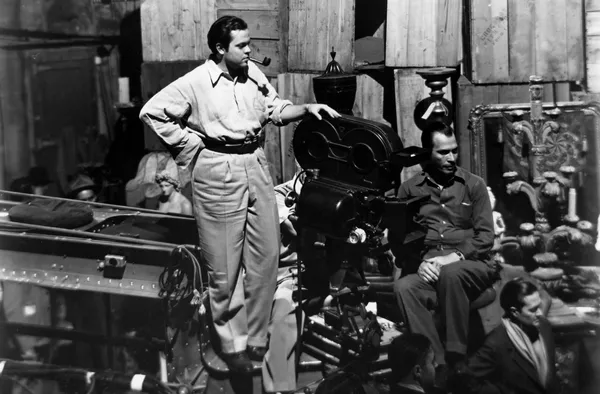
If space allows - and space is part of this, a love letter to Welles, a man who loved himself. Not just as Narcissus, but as actor, husband, director, father, artist. A Renaissance man, Welles, stage and screen and radio and chalk and oil and wash and felt-tip. A man whose art is revealing, not just about his work, but about himself. As with Saving Brinton, there's archaeological value in ephemera, artistic insight in marginalia. I'd buy a coffee table book of Welles' Christmas cards, still lives at times revealing as much as the self portraits, proportionate analysis of the balance of bottle and broken-veined bonhomie.
 If space allows, sit in the front row yourself. Drink in the imposition of expressionism through ergonomics, gaze up, craning at shots considered anew. Listen and watch as Mark transports us with a box of art through los ojos, les yeux, as lines are taken for walks.
There's structure - a four-fold framework of analysis - art (those walking lines) animated and graphically enhanced by Danny Carr - footage archive and televisual, and then there are the artifacts. Not just paintings not seen before and immediately given contexts, not just an unopened letter, not just houses and places and drawings and doodles and sketches and palettes and scripts and interviews, but artifacts in the modern sense. A stabilised camera, descendant of the computer controlled filmic megafauna of the Star Wars that helped build the compositions that created the terrain where Welles could break the hearts of a generation and transform them into the kind of people who would build the platforms where they could share not only the worst moments of his career but re-examine his critical legacy. Platforms whose attempts to transfer data fail in ways that create happy accidents - ever a strength of art is owning your mistakes, especially the ones that work.
This is a dialogue of sorts - albeit one-sided. Much is made of Don Quixote, and it is tempting to cast Cousins in the mould of Panza, straining to see what his master has gazed upon from the bony shoulders of Rosinante. The proportions are reversed, however, not room behind one for t'other to cower, and Welles deep in the ground, Mark in the air, travelling.
There are among the destinations Arizona and Spain and France, buttes and bulls and boulevards, Cousins and Welles, ever, both masters of this, perspective. Welles as pawn, knight, king, jester, in life and light and love, but Cousins too: enthralled by the work, drawn on, leaning in; approaching with intent but from an angle, lancing across to an idea that by-itself out-flanks; autocratic. This is his film, summoned by taxi-cab and convected in layers of airy bubble-wrap to his flat, a singular vision of a singular vision; lastly ludic, that dialogue of sorts suggests Cousins too can conjure with the voices that have inspired him.
I note that in this piece about two film-makers whose work I greatly enjoy I have given rein to the comma and the hyphen. I will claim responsibility lies with their multi-faceted exploits, as writers, directors, cineastes, cinephiles, and so forth. The over-use of the em dash - the textual equivalent of the lazy cutaway - is your reviewer's own stylistic tic. That's a product of circumstance, perhaps - I am ever with Hemingway on writing long because I did not have the time to write short, and I am typing at a small table in a corner of Festival HQ rather than wait to try and coax words from the comfort of a coach. Here Cousins' canvas is the screen itself, but upon it we see not only other canvases, museum walls bearing them, films projected upon them. Herein advanced is a relatively robust and useful critical lens, one that holds attention. The Eyes Of Orson Wells deserves to be met with your own.
Reviewed on: 22 Jun 2018

If you like this, try:
Review preview for Jodorowsky's Dune
Jodorowsky, amazingly vigorous at 84, is never anything less than captivating, funny, and passionate when on screen.
Review preview for Light Years
I'm not sure it constitutes scholarship in and of itself, but it is certainly (as with all good documentary) a satisfying look at something hereto unseen.
Review preview for What Is This Film Called Love?
Like the pop-science writer Jonah Lehrer (who Cousins speaks of almost as if he were a guru), Cousins can be inspiring, his enthusiasm contagious; even if some of his details don’t seem to stand up well to scrutiny.